
Full Circle Bioconversion LLC: Turning food waste into a business
Full Circle Bioconversion LLC: Turning food waste into a business
Lycoming County |Pine Creek Valley and PA Grand Canyon & I-80 Frontier Landscape of the PA Wilds

As a child, the Pennsylvania woods were Aubrey Fornwalt’s playground and the stream was her pool. After a life change in 2016 led her back to her childhood home in Lycoming County, Fornwalt took a risk and bought some black soldier flies for a composting business, taking inspiration from the woods and insects she loved as a child.
Two years later, it grew into what would become Full Circle Bioconversion, based in the city of Williamsport in the Pine Creek Valley and PA Grand Canyon landscape and I-80 Frontier landscape of the Pennsylvania Wilds region.
Fornwalt’s goal is to help individuals and businesses reduce the amount of food that ends up in a garbage can instead of a compost bin.
“There is a tragic amount of food that is thrown away in landfills,” she says. “The true ‘waste’ of this potential resource was the act of throwing it into a pile where the food becomes methane and leachate. My goal is to create an easy service that caters to homes and businesses to help keep food scraps out of the landfill and retain it for our food system.”
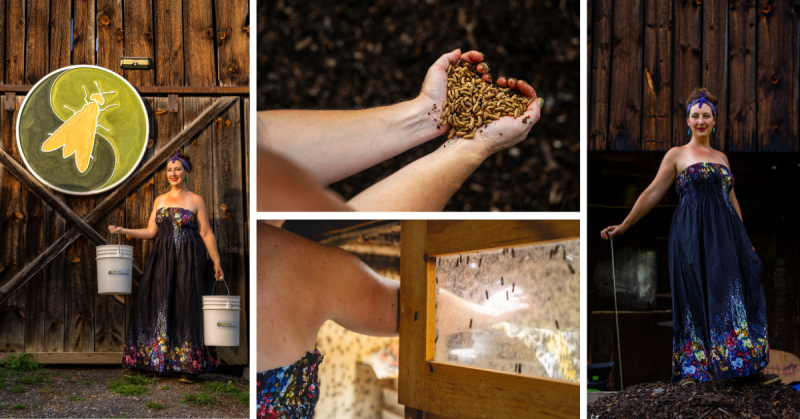
How does black soldier fly composting work, and why is it faster than traditional composting? There is very little that these larvae won’t eat, and they even prefer breads, meat and dairy. Full Circle Bioconversion’s “do not include” list is very short.
“I had weighed all the logistics for a big operation with a concrete compost pad with heavy equipment, and it felt like a big risk, considering that it very well might not be successful with so much money invested up front,” says Fornwalt. “More research led to the discovery of a certain species of fly larvae that is used in other regions to dramatically reduce the volume of food scraps. This new approach resonated with the spirit of the little girl who didn’t mind the bugs and critters of her childhood. This is how I began my black soldier fly journey.”
Compost is great for gardens and landscapes, but so is the larvae manure, also known as “frass.” In addition to getting rid of the food waste in a sustainable way, these larvae also create a product that Fornwalt can sell.
“If I bring in about 1000 pounds of food scraps a week, about 60-75 pounds of frass accumulates in that week,” Fornwalt says. “And for anyone who enjoys feeding birds or chickens, the larvae are available in dried form to supplement any protein or fat needs in their diet. Bonus feature: if squirrels plague your feeders in the winter time, they don’t like larvae.”
It should be noted that this fly is a non-vector because it does not eat. It will not bite or sting because it simply can’t. At about an inch in length, its only defense mechanism is that it might resemble a wasp, but it is very docile. It lives only 4-7 days to mate and lay eggs, seeing the species to another generation. Because the adult stage is so short, the larvae are voracious and will consume the calories necessary for the adult fly.
In 2018, Full Circle Bioconversion LLC was formed, and in July 2020, it was officially permitted through the Department of Environmental Protection to begin composting food scraps via black soldier fly larvae.
As of August 2026, Full Circle Bioconversion has diverted over 243,600 pounds of food scraps from the landfill since 2020. (That statistic is updated regularly on www.fullcirclebioconversion.com.)
Full Circle Bioconversion works with local restaurants who value the importance of keeping food within its intended cycle: Kathy’s Cafe in Hughesville and Bullfrog Brewery in Williamsport. They have just completed a second year of assisting Major League Baseball with diverting food from the landfill at the Braves vs. Brewers Little League Classic this August at Historic Bowman Field.
Fornwalt continues to innovate and grow her business. Maintaining an insect-centric operation through the four seasons here in Pennsylvania is challenging, but it is very possible. Fornwalt has experimented with tapping into the heat generated from the compost pile to heat water as well as larvae themselves to maintain a warm space even in the winter months.
Some other specifics about this black soldier fly larvae operation:
- 800-1000 pounds of food scraps come in weekly
- 50-80% of that volume is reduced – converted into frass (larvae manure) and larvae
- 12’x12’ room is the room size that this food scrap reduction primarily takes place in
- 12’x12’ aerated static compost pile manages any residue from the larvae bins and other material the larvae can’t consume
Tapping into biological solutions – such as composting and insect bioconversion – opens up a tremendous amount of opportunities to work with nature. This operation is a resource management solution in a small land footprint that can help divert food scraps from the landfill while creating resources that will feed our future selves.
Fornwalt explains, “Our land will rebound with resiliency when we prioritize our soil health, and those benefits will expand broadly from farm to table back to farm. It is a circle – as nature intended.”
Full Circle Bioconversion LLC is a Resource Partner within the PA Wilds Cooperative. Learn more about Full Circle Bioconversion LLC by visiting their PA Wilds Cooperative profile or by searching the directory at members.pawildscenter.org.